

ON THIS PAGE
Tafric request data as of October 30, 2026
Across Africa, entrepreneurs search Google for 'maize milling machine price in Nigeria', 'oil press machine made in Turkey' or 'bakery equipment from Turkey'. This guide is for buyers setting up or expanding a mill, bakery, oil press or small food factory who want to buy food processing machines from Turkey directly from the manufacturers.
Short answer
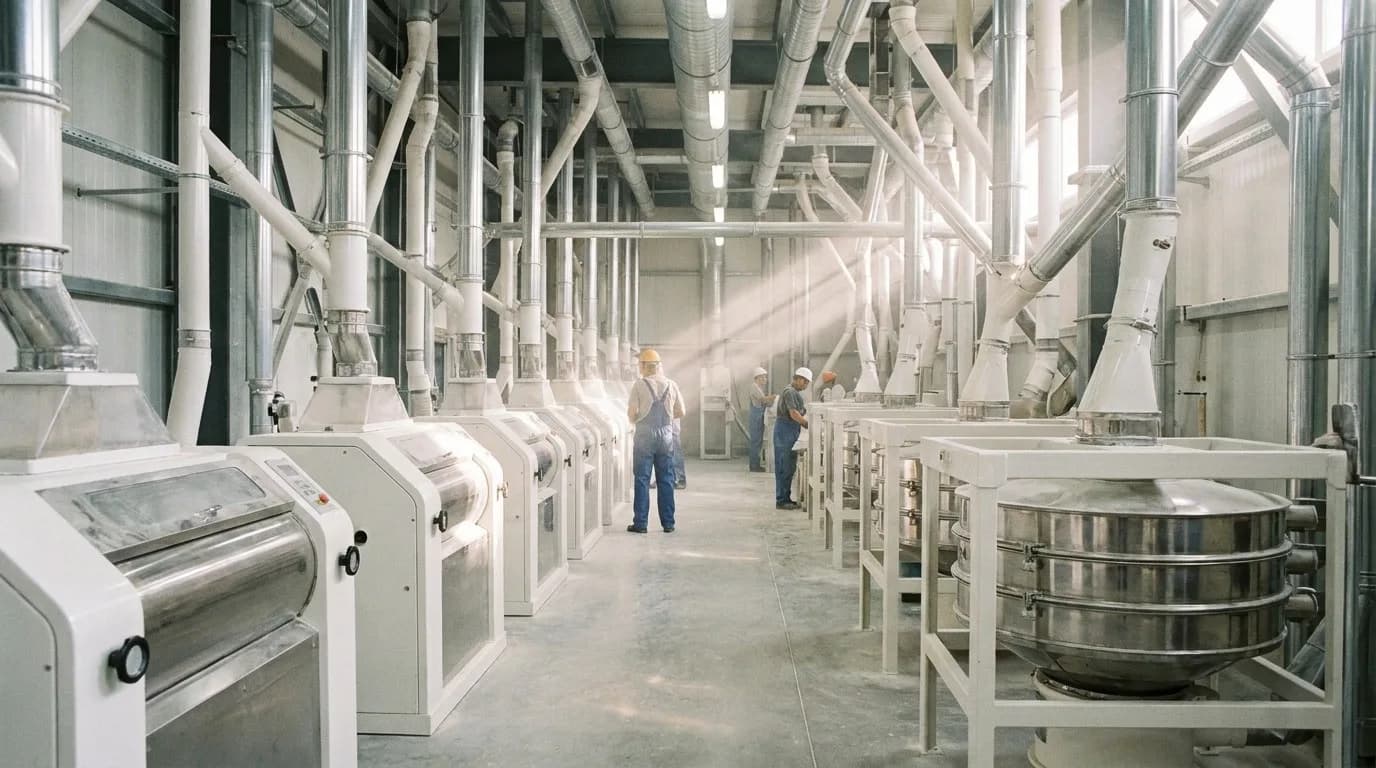
Turkish manufacturers build maize and flour mills, oil presses, bakery ovens and dough mixers, packing and filling machines and complete small processing lines, and they sell a lot of this equipment abroad: in 2024 Turkey exported about $200 million of grain milling machinery, with Cameroon, Zambia, Angola and Kenya among its buyers in Africa (UN Comtrade data). Build your request on three things: the product you will make, the output you need per hour or per day, and the power available on site.
Turkey, China, Europe or a local fabricator?
Buyers compare four sources. Local fabricators, common for garri and small maize mills, are close and easy to repair, but finishing and food-contact materials vary. Chinese factories offer the widest range of small machines, often at the lowest list price; check what is included, spare parts, manuals and after-sales support before you pay. European brands are known for high-end bakery and milling equipment, at a higher price. Machines sold in Turkey must carry CE marking under rules aligned with the EU, and many Turkish manufacturers sell complete lines and can send technicians for installation and training. Ask each supplier what is included, and compare the whole line delivered and installed, not the price of one machine.
Which machines for which business?
| Business | Typical machines | Tell the supplier |
|---|---|---|
| Maize, millet or cassava flour | Cleaner, dehuller or degerminator, hammer or roller mill, sifter, bagging scale | Raw material, kg per hour, fineness, bag sizes |
| Garri, attiéké, cassava chips | Peeler, grater, press, dryer or roaster, mill | Tonnes of roots per day |
| Bakery | Spiral mixer, divider, moulder, proofer, rotary or deck oven | Bags of flour per day; gas, diesel or electric |
| Edible oil (palm, groundnut, soya, shea) | Seed cleaner, screw press (expeller), filter; refining for larger plants | Seed type, tonnes per day, cold or hot press |
| Snacks, pasta, biscuits, infant flour | Slicer, fryer, extruder, pasta or biscuit line | Product, kg per hour |
| Packing | Powder or granule packer, liquid filler, sachet sealer | Product and pack sizes (100 g, 1 kg, 25 kg) |
Requests on Tafric show what African buyers actually ask for: semi-industrial units rather than giant plants. Examples from recent requests include a maize flour line of 100 to 500 kg per hour with cleaning, milling, sifting and bagging, a 50 kg dough mixer with a rotary oven, an oil press for 3 to 5 tonnes of seed a day, and powder packing in 100 g and 200 g bags.
Power, capacity and build quality
Check the power before anything else. Turkey and these African markets all use 50 Hz; single phase is 230-240 V and three phase 400-415 V. Larger mills, presses and electric ovens usually need three-phase power, so if your site has only single phase or no grid at all, ask for diesel-driven mills, gas ovens or a generator sized for the line. Ask for food-contact parts in stainless steel (AISI 304 is the usual food grade), the motor brand and power in kW, and the real output with your raw material, because moisture and hardness change the capacity. Size the line for the raw material you can buy and the volume you can sell, not for the biggest machine.
What drives the price
The price depends on the output, the degree of automation, stainless or painted steel, motor and electrical brands, a single machine or a complete line with cleaning, drying and packing, installation and training, the spare parts kit and seaworthy packing. Ask every supplier for the same itemised list: each machine with its capacity and power, conveyors and cyclones, control panel, spare parts, installation, and the price to your port (CFR) or at the Turkish port (FOB).
How to import food processing machines from Turkey, step by step
1) Write down the product, the output per hour or per day, your raw material and your power supply. 2) Post a request with photos of the site and of the product you want to make. 3) Compare suppliers on the same itemised list, and ask for a layout drawing and a video of the machine running, ideally with a raw material like yours. 4) Agree in writing the specifications, delivery time, installation and training, warranty and spare parts; use a letter of credit or payments linked to production milestones. 5) Before shipping, check a video test run and the packing, and get the commercial invoice, packing list, certificate of origin and your country's conformity documents. 6) Prepare the floor, power and water connections before the machines arrive. Our guide to finding and verifying Turkish manufacturers helps with step 3.
Shipping and customs
In Nigeria, machinery falls under SONCAP; a manufacturer importing machinery for its own production can apply to SON for a SONCAP import permit instead of the usual certification. In Kenya, goods need a PVoC certificate unless exempt, and registered manufacturers can apply to KEBS for an exemption for machinery for their own use. Senegal and Côte d'Ivoire usually require a cargo tracking note (BSC), Cameroon a BESC and DR Congo a FERI. Rules change, so confirm them with your clearing agent before shipping. See our guides on importing from Türkiye to Nigeria, to Kenya, pre-shipment inspection and container freight.
How Tafric works for buyers
Posting a request is free. Tafric checks it before it goes live, then Turkish food machinery manufacturers see it and contact you directly. You compare, ask questions and agree terms with the supplier you choose. Post your request or browse machinery from Turkish suppliers.



Frequently asked questions
How much is a maize milling machine in Nigeria?
It depends on the output per hour, the flour fineness, whether you need cleaning, degerming and bagging, and whether the mill runs on electricity or diesel, so a single price is misleading. Post your raw material, output and power supply, and compare itemised prices delivered to your port.
Can I buy food processing machines from Turkey?
Yes. Turkish manufacturers sell mills, oil presses, bakery equipment, packing machines and complete lines to Africa. Post a free request on Tafric and they contact you directly.
What do I need to start a maize milling business?
At least a cleaner, a dehuller or degerminator if you sell fine flour, a hammer or roller mill, a sifter and a bagging scale, plus enough power, a dry store for the grain and a steady maize supply. Size the mill for the maize you can buy and the flour you can sell.
Do I need three-phase power for a flour mill?
Larger mills, oil presses and electric ovens usually do. If you only have single phase or no grid, ask for diesel-driven mills, gas ovens or a generator sized for the line.
Turkish or Chinese machines: which should I choose?
Chinese machines are often cheaper on paper; many Turkish suppliers sell complete lines with installation support, and Turkey is a shorter sea route to North and West Africa. Compare stainless steel parts, motor brands, real output, spare parts and after-sales service, not just the price.
How do I post a food machinery request?
Write the product you will make, the output per hour or per day, your raw material, your power supply and your city, add photos of the site, then publish. It is free, and Turkish manufacturers contact you directly.