


ON THIS PAGE
Tafric request data as of November 25, 2026
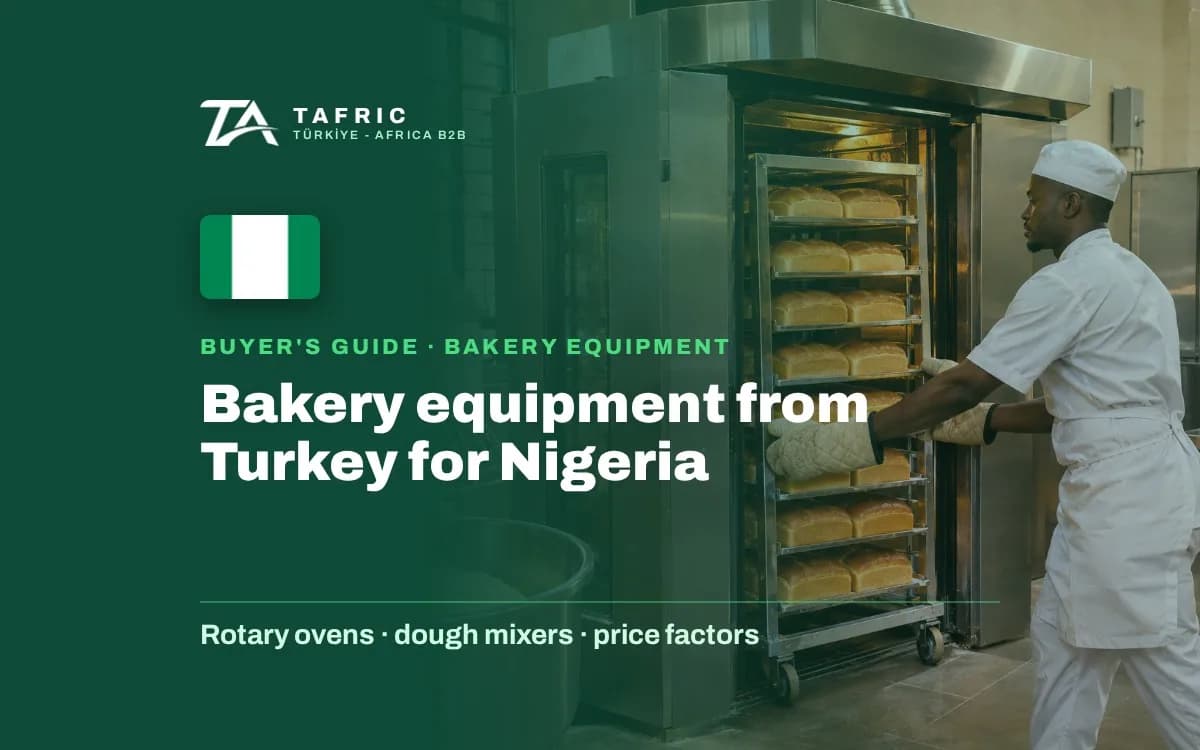
The price of bakery equipment in Nigeria depends mainly on the oven type and size (rotary rack or deck oven, number of trays or decks), the fuel (diesel, gas or electric), the mixer capacity and how complete the line is, plus freight, duty and clearing to Lagos. Turkey exported about $124 million of bakery and pasta machinery in 2025 (UN Comtrade), with Konya and Istanbul among the main production centres, so fix your specification first and compare Turkish suppliers on the same list.
Tafric is a B2B marketplace that connects Turkish manufacturers with African buyers: the buyer posts a request for free, Tafric checks it, and Turkish manufacturers in that category can contact the buyer directly.
What decides the price of bakery equipment in Nigeria?
Bakery equipment prices in Nigeria are set by five things: the oven's capacity and build, the fuel and burner, the mixer's real capacity, the number of machines in the line, and the landed costs between the factory and your bakery. A single "rotary oven price" or "50 kg mixer price" means little until these are written down, because two machines with the same name can differ in steel thickness, insulation, burner and motor.
| Price factor | What changes the price | What to write in your request |
|---|---|---|
| Oven type and size | rotary rack oven (number of trays per trolley) or deck oven (number of decks and trays per deck) | for example "rotary oven, 18 trays of 60 × 80 cm" or "3-deck oven, 2 trays per deck" |
| Fuel and burner | diesel, LPG, natural gas or electric; burner quality decides fuel use and reliability | the fuel you can buy every week, and whether you need a dual-fuel burner |
| Build | stainless steel inside and out or painted steel, insulation thickness, steam system | stainless steel for parts touching dough, steam generator yes or no |
| Mixer | spiral or fork mixer, capacity in kg of flour or kg of dough, fixed or removable bowl, one or two speeds | bags of flour per batch and per day |
| Line | mixer only, or divider, rounder, moulder, proofer, slicer and trolleys | the bread you make and how many loaves per day |
| Power | single phase or three phase, motor kW | your supply: Nigeria uses 230 V single phase and 415 V three phase, 50 Hz |
| Landed cost | sea freight, insurance, duty and VAT, clearing, transport to the bakery, installation | your city, and whether you need a technician on site |
Ask every supplier for the same breakdown: price per machine, what is included (trays, trolleys, spare burner nozzles, elements, belts), the packed size and weight, and the price at the Turkish port (FOB) or to Lagos (CFR). Cargo insurance for Nigerian imports must be placed with a Nigerian insurer, so ask for FOB or CFR rather than CIF; our import duty in Nigeria guide shows how to turn a factory price into a landed cost.
What is the bakery equipment list for a bread bakery in Nigeria?
A bread bakery in Nigeria needs, at minimum, a dough mixer, a way to sheet or knead the dough, a moulder, baking pans, a proofing area and an oven, and larger bakeries add a divider, rounder, proofer, cooling racks, slicer and packing. Buyers on Tafric describe it in their own words, such as "oven, miller, panner and moulder" or "a complete set of bakery equipment", and one asked for a 25 kg dough mixer and an oven for 100 loaves a batch.
| Machine | What it does | Tell the manufacturer |
|---|---|---|
| Spiral dough mixer | mixes and kneads the dough | flour per batch in kg, fixed or removable bowl, voltage |
| Dough brake or sheeter (often called a "dough miller" in Nigeria) | rolls stiff dough between rollers for the dense, smooth Agege-style loaf | send a video of the machine you use now; roller width, motor, manual or automatic |
| Divider and rounder | cuts the dough into equal pieces and rounds them | piece weight range in grams, pieces per hour |
| Moulder | shapes the pieces into loaves | loaf length and type (tin bread, long loaf, rolls) |
| Proofer (proving cabinet) | lets dough rise at controlled warmth and humidity | trolleys per load, heating source |
| Oven | bakes the bread | rotary or deck, trays, fuel, loaves per batch |
| Pans, trays and trolleys | hold the bread through proofing and baking | pan sizes for your loaf weights, number of trolleys |
| Bread slicer and packing table | slices and bags sliced bread | loaf length, blade spacing |
The dough brake is the machine behind Agege bread: the dough is squeezed again and again between a pair of rollers until it becomes smooth and stiff. Turkish manufacturers build dough sheeters and roller machines, but a Nigerian-style dough brake is a specific design, so describe it clearly, send photos or a video and ask whether the factory has built one before.


Browse industrial machinery from Turkish manufacturers or post a free request with your equipment list, the bread you make and your city, so it reaches the machinery manufacturers on Tafric. For mills, oil presses and other food lines, see our food processing machines guide.
Rotary oven or deck oven: which is better for bread in Nigeria?
A rotary rack oven suits bakeries that bake large batches of tin bread, because a whole trolley of trays turns inside the oven and bakes evenly with hot air, while a deck oven suits smaller bakeries and crusty or varied products, because each deck works separately and bakes on a hot stone or steel floor. A growing bakery can start with a deck oven and add a rotary oven when daily volume rises.
| Rotary rack oven | Deck oven | |
|---|---|---|
| Batch | one trolley of trays at a time | one to several decks, loaded separately |
| Best for | high volume of the same loaf, tin bread, rolls | smaller volume, crusty bread, cakes and mixed products |
| Floor space and access | needs a wide door and floor space for the trolley; can be shipped in parts and assembled on site | compact; stone-floor models are heavy |
| Fuel options | diesel, gas or electric | gas or electric, some diesel |
| Ask about | trays per trolley and tray size, burner, steam, rotation motor | number of decks, trays per deck, stone or steel floor, steam |
Fuel decides the running cost more than the oven price does. Buyers on Tafric have asked for LPG or CNG gas ovens and for gas and charcoal ovens, so tell the manufacturer which fuel you can rely on every week and ask for the burner's fuel use per hour at full load. An electric oven needs a large three-phase supply, which not every Nigerian site has reliably; if you plan to run it on a generator, give the manufacturer the oven's total kW so the generator can be sized.
What size dough mixer do you need: 25 kg or 50 kg?
A "50 kg mixer" can mean 50 kg of flour or 50 kg of dough, so always ask which one the manufacturer means, because dough weighs much more than the flour in it. As a rule of thumb, with about 60% water (stiff Agege dough uses less), 25 kg of flour (half a bag) makes roughly 40 kg of dough, and a full 50 kg bag makes roughly 80 kg; a mixer rated for 50 kg of dough therefore takes only about 30 kg of flour.
Size the mixer from your daily plan: the bags of flour you will bake per day, how many batches your team can mix in a shift, and the oven's capacity per batch. The oven and mixer must match; there is no point buying a mixer that makes dough faster than the oven can bake it. Ask for a spiral mixer with a removable bowl if you bake several products, and check the motor's kW against your power supply.
Does Turkey make bakery machines, and how do they compare?
Turkey makes the full range of bakery equipment, from spiral mixers and dough sheeters to rotary and deck ovens and complete bread lines, with Konya and Istanbul among the main production centres. Turkey exported about $124 million of bakery and pasta machinery (HS 8438.10) in 2025, up from about $101 million in 2024, plus about $17 million of non-electric bakery ovens (HS 8417.20), according to UN Comtrade.
Algeria was the largest buyer of Turkish bakery and pasta machinery in 2025, followed by Russia, with Iraq, Saudi Arabia and Germany also among the buyers. Nigeria is still a small market for these Turkish machines: of the about $11 million of bakery and pasta machinery Nigeria imported in 2025, Italy and China supplied about $4 million each, South Africa about $1.4 million and Turkey about $0.2 million, according to Nigeria's figures reported to UN Comtrade.
| Source | What to check |
|---|---|
| Local fabricators in Nigeria | close by and easy to repair; check finishing, insulation and food-contact materials |
| China | a wide range of small machines; check what is included, spare parts and after-sales support |
| Italy and other European makers | mixers and ovens built to European specifications; check spare parts and service in Nigeria |
| Turkey | complete bakery lines, diesel and gas ovens, CE marking on machines sold in Turkey; check export experience, manuals and spare parts |
Ask each supplier for the steel grade of the parts that touch dough, the burner and motor specifications, the CE declaration of conformity, the warranty, English manuals and wiring diagrams, and a list of spare parts that should travel with the machines. NAFDAC's 2025 guidelines for bread factories ask that equipment parts in contact with the product be made of non-toxic materials such as food-grade stainless steel.
How do you import bakery equipment from Turkey to Nigeria?
To import bakery equipment from Turkey to Nigeria, get the SONCAP Product Certificate for the machines, open an e-Form M through your bank with it before shipment, obtain the SONCAP Certificate for the shipment, pay into the supplier's company account, ship by container to Lagos (about 4–6 weeks at sea, depending on the service and transhipment) and clear the goods with a licensed customs agent. Mixers and bakery machines usually fall under HS heading 8438, non-electric bakery ovens under 8417.20 and electric bakery ovens usually under 8514; the duty follows the exact tariff line, so confirm each code with your agent before you order.
| Step | What to check |
|---|---|
| 1. Specification and HS codes | one equipment list with capacities, fuel and voltage; HS codes and duty confirmed by your customs agent |
| 2. Supplier and proforma | compare two or three Turkish manufacturers on that list; proforma invoice on FOB or CFR Lagos terms, with packed sizes and weights |
| 3. SONCAP Product Certificate | machines are SON-regulated products: machines imported for resale need a Product Certificate (to process Form M) and a SONCAP Certificate for each shipment (for customs clearance), while a manufacturer importing its own production machinery can ask SON whether it qualifies for a SONCAP Import Permit instead; SON decides case by case, and goods arriving without SONCAP face detention, testing and a penalty |
| 4. Form M | e-Form M opened through an Authorised Dealer Bank, with the Product Certificate attached, before the goods ship |
| 5. Shipping | a complete line may need a 40 ft container; a single mixer or deck oven can go in a shared container (LCL); large ovens can be shipped in parts |
| 6. Clearance and installation | PAAR and customs clearance by a licensed agent; agree in writing who installs the oven and connects the burner |
Your bakery also needs its own NAFDAC listing before you sell bread: NAFDAC inspects the bread factory and issues a registration number for each bread variant, and bread must not contain potassium bromate. The full import process is in our guide to importing from Turkey to Nigeria, and shipping from Turkey to Nigeria explains sea and air options to Lagos.
How Tafric helps Nigerian bakers buy equipment from Turkey
On Tafric you post your bakery equipment request for free; Tafric checks it, and Turkish machinery manufacturers in the category can contact you directly with photos, catalogues and prices. Write the machines you need, the bags of flour per day, the fuel, your power supply and your city, and add a photo or video of any machine you want copied. Post your request.
Frequently asked questions
How much is a rotary oven in Nigeria?
It depends on the number of trays per trolley, the tray size, the fuel (diesel, gas or electric), the steel and insulation, plus freight, duty, clearing and installation. Fix the specification first, then compare suppliers' prices for the same oven at the Turkish port or to Lagos.
What is the price of a 50 kg dough mixer in Nigeria?
First ask whether "50 kg" means flour or dough: a mixer rated for 50 kg of dough takes only about 30 kg of flour. The price then depends on the motor, bowl, speeds and build, plus the landed costs to your bakery.
Which oven is best for bread in Nigeria, rotary or deck?
A rotary rack oven suits large batches of tin bread; a deck oven suits smaller volumes and mixed products. Choose by your daily bags of flour and by the fuel you can rely on, diesel, gas or electric.
What equipment do I need to start a bakery in Nigeria?
At minimum a dough mixer, a dough brake or sheeter, a moulder, pans and trays, a proofing area and an oven; larger bakeries add a divider, rounder, proofer, slicer and packing table. Your bakery also needs a NAFDAC listing before you sell bread.
Can I buy bakery machines from Turkey?
Yes. Turkish manufacturers, many of them in Konya, with others in Istanbul, make mixers, sheeters, rotary and deck ovens and complete bread lines, and exported about $124 million of bakery and pasta machinery in 2025. Post a free request on Tafric and let them contact you.
Do bakery machines need SONCAP in Nigeria?
Yes, machines are SON-regulated products. Machines bought for resale need a SONCAP Product Certificate (for Form M) and a SONCAP Certificate (for clearance); a bakery importing machines for its own production can ask SON whether a SONCAP Import Permit applies instead. Confirm the requirement for your machines with SON or your customs agent before shipment.
The Tafric Editorial Team writes export, import and shipping guides for trade between Türkiye, Africa and the Middle East. Articles use data from real buying requests published on Tafric (with no personal information, stating the period covered) and official sources such as customs authorities, trade ministries, UN Comtrade and the World Bank. Articles get a second review of figures and regulations before publication and are updated when rules change. Details: our Editorial policy page.